Visions of Jazz:The First Century by Gary Giddins
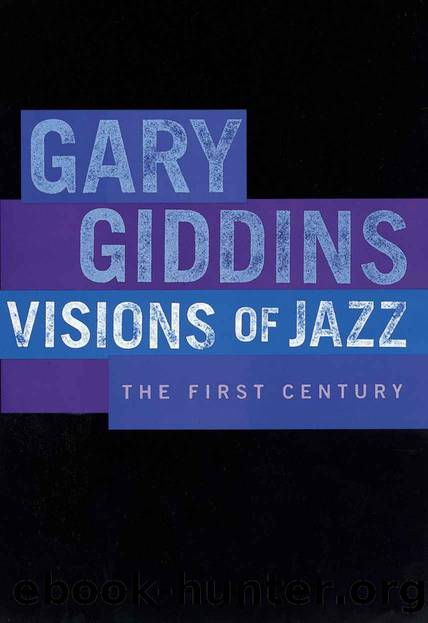
Author:Gary Giddins [Giddins, Gary]
Language: eng
Format: mobi
Publisher: Oxford University Press
Published: 2000-05-17T16:00:00+00:00
40 Art Blakey (Jazz Messenger)
Art Blakey’s death from lung cancer on October 16,1990, at seventy-one, robbed the world of music and the city of New York of a kind and faithful sorcerer. His legacy was threefold, as drummer, bandleader, and teacher. I’m not at all sure in what order of importance those gifts ought to be gauged. During his last thirty-five years, he led an ensemble that not only ranked among the most rewarding in jazz, but remained absolutely trustworthy as an indicator of the music’s future. This despite the relatively immutable style of his Jazz Messengers. The fact is, no one in any style of American music apprenticed more musicians who went on to bigger, if not always better, things. He was an advocate for musicians and a prosyletizer to the general public. His devotion to jazz, his sermonlike effusions on its behalf, characterized the man as surely as his ability to drum audiences into a state of unembarrassed elation.
As he grew older and his hair grayed, Blakey affected the mannerisms of a country boy, simple and earthy. He’d wear overalls and a stetson and sing. He was squat but muscular, and vain about his fitness. He had one of those matchless faces that are both homely and charismatic, and the image of his head thrown back while he comps a soloist, his mouth open to reveal parallel fences of perfect gleaming teeth, is as iconographic as Dizzy’s cheeks and Lester’s hat. The earthiness was more than affectation. He came out of the Pittsburgh steel mills, where he briefly worked as a kid, doubling at night as a pianist in clubs. At seventeen, he was leading a fourteen-piece band though he couldn’t read music; he liked to tell how he took up drums one night after another local kid who couldn’t read—Erroll Garner—showed him up at the piano. The owner of the place insisted Art switch to drums, and since he carried a .350 magnum, Blakey consented. In 1942, he joined Mary Lou Williams’s band at Kelly’s Stable, the first in a long line of New York clubs he made his own, followed by a lengthy tour with Fletcher Henderson. Chick Webb and Sid Catlett were his models, but he was on to something else. What that was became clear when Dizzy Gillespie recruited him for the Billy Eckstine Orchestra.
With that gig, which lasted nearly three years, he affirmed his stature (along with Max Roach and Kenny Clarke) as one of the premier drummers of the new music, modern jazz, bebop. You can see the eminent jaw in old clips of the Eckstine band, presiding over the ensemble as he executes a fiery break or spurs soloists with deft explosions. Blakey was an emphatic drummer, instinctive and always musical. Great drummers are not always great listeners, as countless disgruntled soloists will tell you, but Blakey was. With his impeccable sense of dynamics and drama, he’d stay out of the way when a solo was hot, though he’d counter with ingenious fills.
Download
This site does not store any files on its server. We only index and link to content provided by other sites. Please contact the content providers to delete copyright contents if any and email us, we'll remove relevant links or contents immediately.
The Goal (Off-Campus #4) by Elle Kennedy(13627)
Kathy Andrews Collection by Kathy Andrews(11777)
Diary of a Player by Brad Paisley(7531)
What Does This Button Do? by Bruce Dickinson(6176)
Assassin’s Fate by Robin Hobb(6173)
Big Little Lies by Liane Moriarty(5760)
Altered Sensations by David Pantalony(5080)
Pale Blue Dot by Carl Sagan(4969)
Sticky Fingers by Joe Hagan(4156)
The Death of the Heart by Elizabeth Bowen(3589)
The Heroin Diaries by Nikki Sixx(3525)
Beneath These Shadows by Meghan March(3285)
Confessions of a Video Vixen by Karrine Steffans(3283)
How Music Works by David Byrne(3239)
The Help by Kathryn Stockett(3127)
Jam by Jam (epub)(3060)
Harry Potter 4 - Harry Potter and The Goblet of Fire by J.K.Rowling(3038)
Computational Linguistics and Intelligent Text Processing: 20th International Conference, CICLing 2019 La Rochelle, France, April 7â13, 2019 Revised Selected Papers, Part I by Alexander Gelbukh(2968)
Strange Fascination: David Bowie: The Definitive Story by David Buckley(2844)
